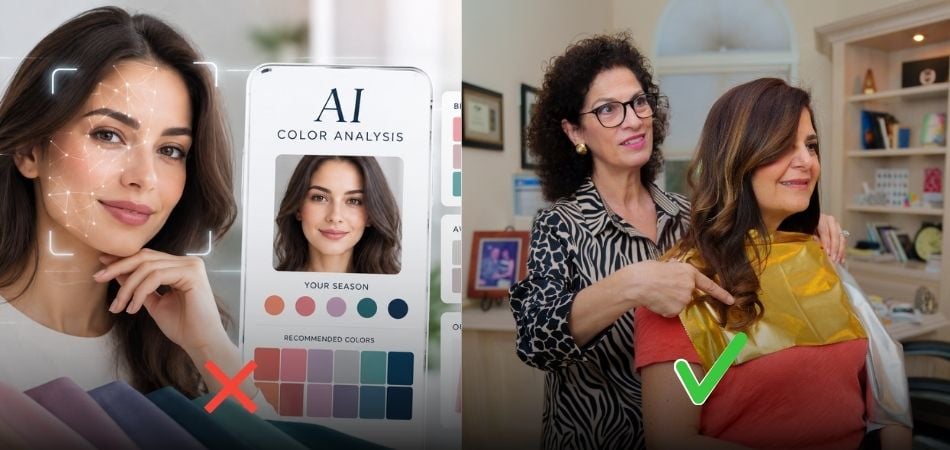
AI color analysis is changing the way people discover and explore color. Upload a photograph, answer a few questions, and within seconds, an algorithm can generate a palette, identify an undertone, or suggest colors that supposedly complement you.
It is fast. It is convenient. And it is impressive.
But color analysis was never simply about identifying colors in a photograph.
It is about understanding the relationship between color and the individual.
And that is where the human eye—and the trained professional behind it—still matters.
AI Color Analysis Can See the Image. But Can It See the Person?
Artificial intelligence is exceptionally good at processing information. It can analyze pixels, recognize patterns, compare colors, and make predictions based on the information it has been trained to process.
But a photograph is only a moment.
A professional color consultant is looking beyond that moment.
They are observing how colors interact with the person’s skin, hair, eyes, contrast, depth, clarity, and overall appearance. They are considering the effect of different fabrics, lighting conditions, makeup, hair color, and even the way a client responds emotionally to certain colors.
Most importantly, they are asking questions.
What does this person want their image to communicate?
What colors make them feel confident?
What happens when a color is too bright, too muted, too deep, or too light?
Which colors support their natural appearance—and which ones compete with it?
Those answers cannot always be found in a photograph.
The Limits of AI Color Analysis
This is one of the biggest misconceptions surrounding automated color analysis.
A person’s appearance can be photographed under different lighting, with different cameras, different white-balance settings, makeup, filters, hair color, and backgrounds.
The same person can look remarkably different from one photograph to another.
An algorithm can analyze the information presented to it.
A trained consultant can question the information.
That distinction matters.
Professional color analysis is not simply about asking, “What color is this person’s skin?”
It is about asking, “How does color behave on this individual?”
That requires observation, comparison, interpretation, and experience.
AI Color Analysis vs. 4X4 Color System®
The Universal 4X4 Color System® – 16 Seasons was developed around a more comprehensive understanding of the individual.
Rather than reducing color analysis to one characteristic, the 4X4 methodology looks at four interconnected dimensions:
Personality. Hue. Value. Intensity.
Each dimension adds another layer to the analysis.
- Hue explores the direction of color and undertone.
- Value considers whether colors are lighter or deeper in relation to the individual.
- Intensity considers the degree of purity, tint, tone, or shading within color.
- And Personality recognizes that color is not simply a physical match. It is also part of how an individual expresses themselves.
Together, these dimensions create the foundation for the 16 Seasons® approach.
This is where the role of the consultant becomes essential.
The system provides a structured methodology.
The consultant brings the observation and interpretation.
16 Seasons® Is Not Just Another Digital Palette
An automated tool can give someone a palette.
But a professional consultation should help someone understand why those colors work.
That difference is significant.
With the Universal 4X4 Color System® – 16 Seasons®, the goal isn’t simply to hand a client a collection of colors and say, “These are your colors.”
It is to understand the relationship between the individual and color.
Why does one version of a color create harmony while another feels overwhelming?
Why can two people wear the same hue but require completely different values or intensities?
Why might a color that technically fits someone’s undertone still fail to support their overall image?
These are the questions that turn color analysis into a professional service rather than an automated result.
The Human Eye Doesn’t Work in Isolation
There is another important point.
When we talk about the human eye, we are not simply talking about eyesight.
We are talking about a trained eye.
Experience changes what a consultant notices.
Training provides a framework for comparison.
Methodology creates consistency.
And working with real people develops the ability to recognize nuances that cannot always be captured in a single image.
The human eye of an experienced consultant isn’t valuable because it competes with technology.
It is valuable because it knows how to interpret what technology sees.
So, Can AI Replace a Color Consultant?
AI can certainly become a useful tool for the image industry.
It can help with education, visualization, research, organization, inspiration, and client engagement.
There is no reason professionals cannot use technology to make their work more efficient.
But using AI as a tool is very different from allowing an algorithm to become the consultant.
A consultation is a human interaction.
It involves observation, questions, dialogue, correction, explanation, and personalization.
And when a consultant works within a structured methodology such as the Universal 4X4 Color System® – 16 Seasons®, technology does not replace that expertise.
It can support it.
The Future of AI Color Analysis
The real opportunity isn’t necessarily to choose between technology and human expertise.
It is to understand where each belongs.
AI can process information incredibly quickly.
A trained consultant can bring context to that information.
AI can generate possibilities.
A consultant can evaluate them.
AI can identify patterns.
A consultant can interpret what those patterns mean for the individual.
And the more advanced the methodology, the more important that human interpretation becomes.
Because the goal of color analysis isn’t to produce a pretty digital palette.
The goal is to help a person understand color—and understand themselves through color.
AI Still Needs the Human Eye
Technology will continue to evolve.
AI will become faster, more sophisticated, and increasingly capable of analyzing visual information.
But the fundamental question remains:
Are we analyzing a photograph, or are we analyzing a person?
The answer changes everything.
The Universal 4X4 Color System® – 16 Seasons® is built around the belief that the person is not the system. The system exists to help the consultant understand the person.
That is why the future of professional color analysis doesn’t have to be about competing with AI.
It can be about knowing how to use technology while protecting what technology cannot replace:
the trained eye, the professional methodology, and the human connection.
Take Your Color Expertise Further
If you want to move beyond automated color matching and develop a deeper, professional understanding of color, the ByFERIAL 4X4 Color Training provides a structured approach to analyzing color through the Universal 4X4 Color System® – 16 Seasons®.
Because technology can give you an answer.
A trained consultant understands the story behind it.